
Hellevator
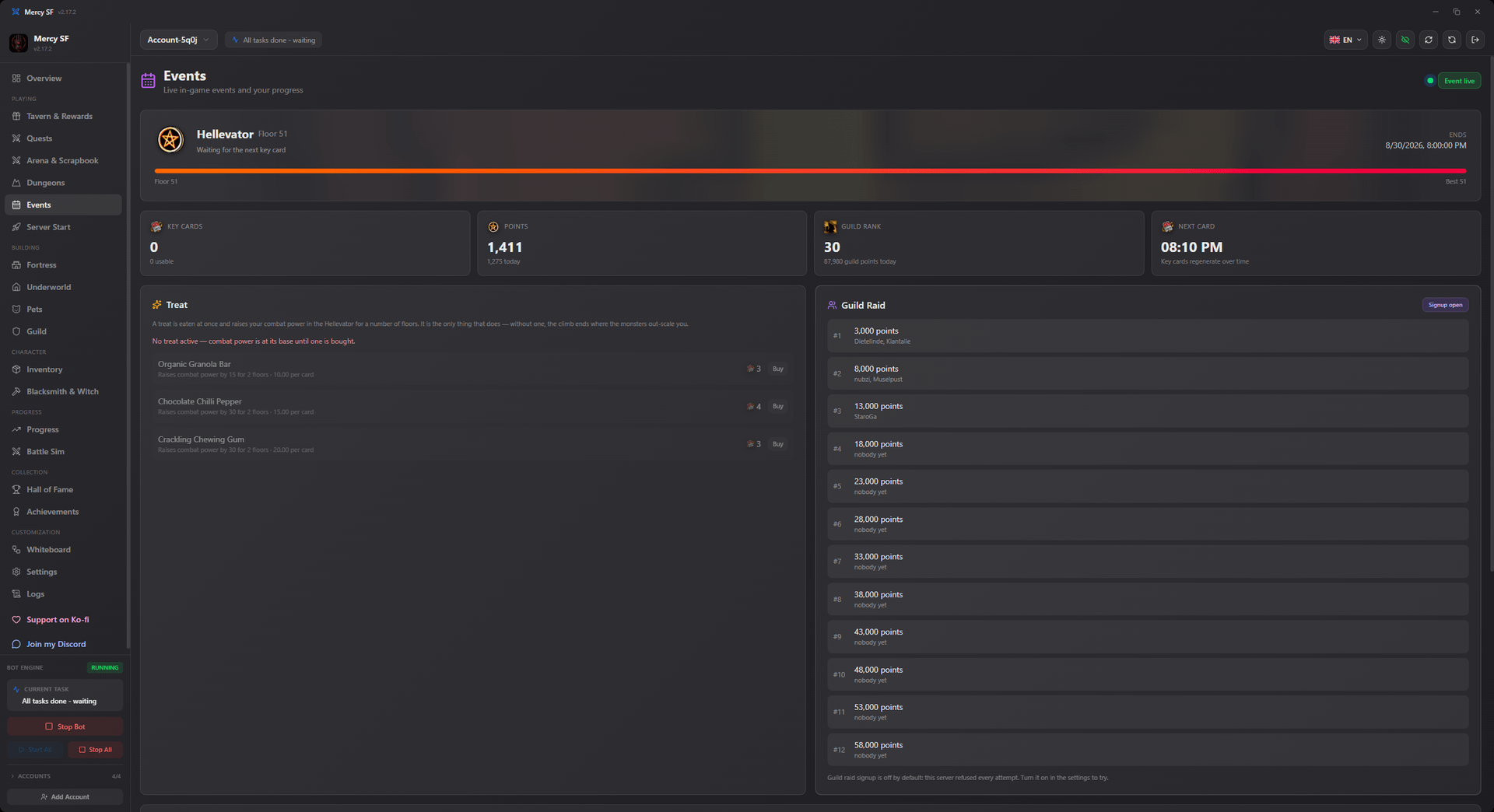
The Hellevator is a climb. You spend key cards on fights, each won fight takes you up a floor, and the monsters scale faster than your character does. Left alone, every account eventually hits a wall and then feeds key cards into fights it cannot win.
The shop, Beelzebub's Emporium, is the only lever on that. A treat is the single thing that changes Hellevator combat power, and it lasts two floors.
Turn it on with auto_hellevator.
What one pass does
The module does four things per day, and it used to need four separate cycles to get around to all of them, because every command sent replaces the game state and a reference taken before a send is stale afterwards. It now re-reads the run between steps and does all four in one pass, which matters most on the day there is most to do.
- Yesterday's reward, if it is still unclaimed.
- Today's reward.
- A treat, if the rules below say one is worth buying.
- Fights, while key cards remain above your reserve.
The treat decision
This is the part worth understanding, because the default is not the obvious one.
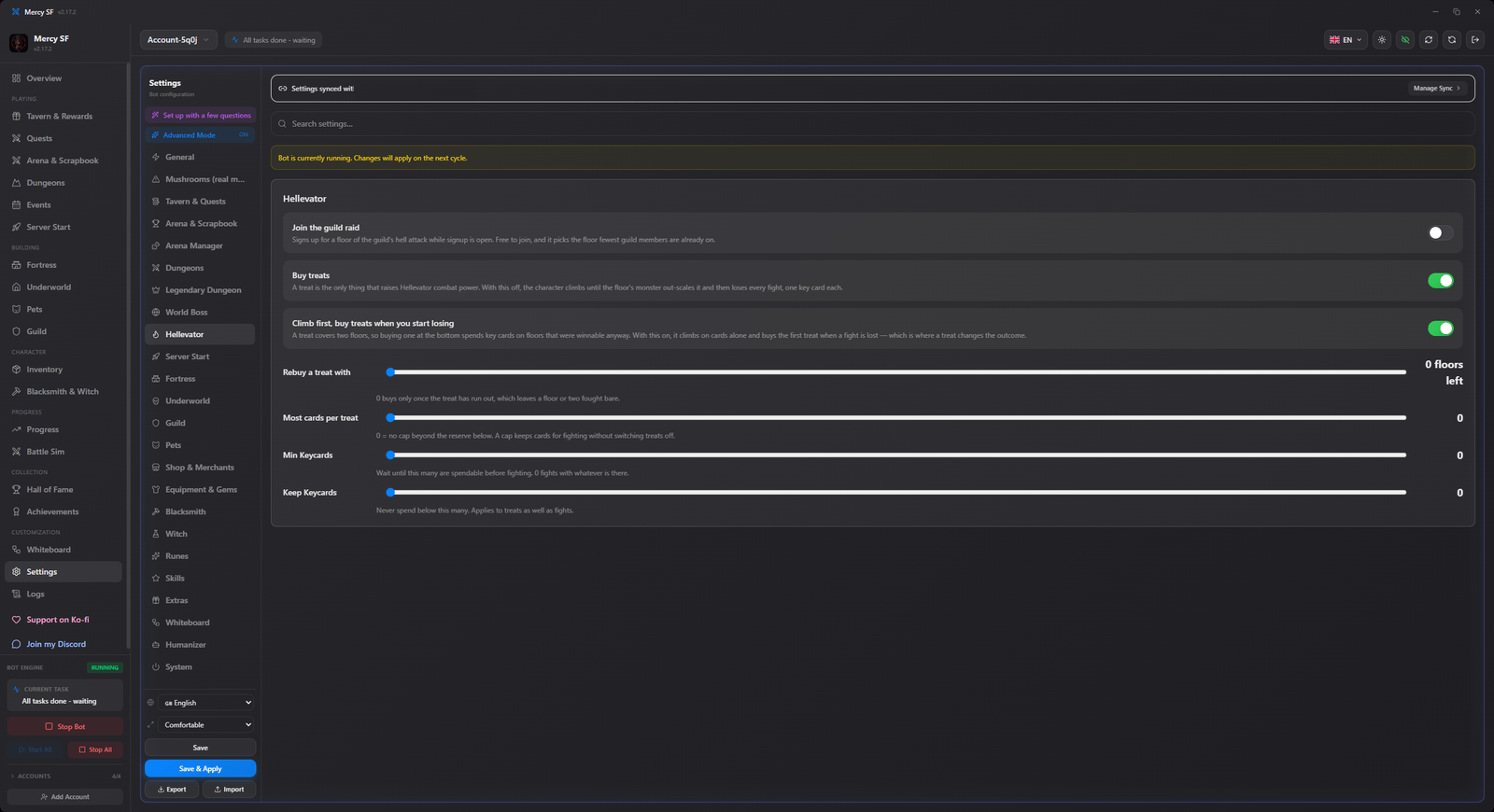
hellevator_treats_after_loss is on, which means: climb on key cards alone until a fight is actually lost, and only then start buying treats.
The reasoning is that a treat lasts two floors. Bought on floor 1, that is two floors of help where none was needed, and the key cards it cost were fights that would have been won anyway. The wall is the moment a treat starts paying for itself, and a lost fight is how the wall announces itself.
Turning it off buys one as soon as the shop and your reserve allow. That climbs more slowly overall but never loses a card to a fight it could not win. Both are defensible; the default picks the one that reaches higher.
Picking which treat
When it does buy, it takes the treat with the best effect times floors, per key card. That comparison is done by cross-multiplying rather than dividing, because integer division throws the remainder away: a treat worth 2.9 per card and one worth 2.1 per card both score 2, and the winner would then be whichever the shop happened to list first. Nothing about that is visible from the outside. The bot simply buys the worse treat sometimes.
Settings
| Setting | Default | What it does |
|---|---|---|
auto_hellevator | on | The module itself. |
hellevator_min_keycards | Do not start fighting below this many cards. | |
hellevator_keep_keycards | Reserve. Cards below this line are never spent. | |
hellevator_buy_treats | on | Buy from the Emporium at all. Off is for somebody who wants every card to go into fights and knows what that costs. |
hellevator_treats_after_loss | on | Wait for a lost fight before the first purchase. See above. |
hellevator_max_treat_price | 0 | Most key cards to put into one treat. 0 means only the reserve limits it. |
hellevator_treat_refresh_floors | 2 | Buy a fresh treat once the current one has this many floors left. 0 means "only when it has run out", which is cheapest and leaves you fighting a floor or two with no treat while the purchase happens. |
hellevator_guild_raid | off | Sign up for the guild's hell attack while the signup window is open. |
Why the guild raid signup is off
Not caution, evidence. Shipped on, it was refused 78 times in one day with tournament raid circle not allowed, on every account. The conditions the server actually applies to that command are not known, so the honest default is not to send it.
The switch stays for anyone who wants to try, and a refusal is now remembered rather than repeated every cycle.
When it stops
The Hellevator carries its own start and end timestamps in the game state, so "is it running" is answered exactly rather than inferred. Outside the window the module does nothing at all. See How events are detected.
See also
- How events are detected
- World Boss
- Legendary Dungeon
- Quests, tavern & expeditions for how beer is handled during an event